Categories
Therapy Counselling Relationships

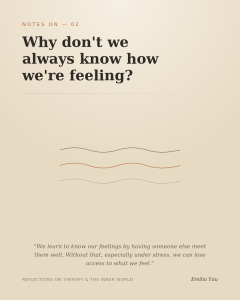
Notes On 02: why don’t we always know how we’re feeling?

People sometimes don’t know how they’re feeling because sometimes it may feel safer not to feel.

I want to talk about something I think is really important. I remember this clearly from my own time as a lawyer. There were moments I genuinely didn’t know what I felt. Imagine if you let yourself feel just how overwhelming or anxiety provoking something really was. Sometimes it felt safer not to feel.

That’s something I now see a lot. When you’re immersed in something demanding, under constant pressure, running on deadlines and performance, it’s genuinely hard to access what you’re feeling in the moment. So we learn to cover feelings over. We lean into thinking, analysing, conceptualising, as a way to cope and keep going. It works, until it doesn’t. That’s often when burnout, anxiety or chronic stress start to show up, this can show as a breakdown in one single crisis, or more slowly where the cost of never quite letting yourself feel what was happening underneath starts to eek away at the connection you have with yourself and others.

We also learn about our feelings through our relationships with others. That’s part of why we talk things through with people, their reactions can either be rejecting or validating. If you have had experiences where it is not ok to talk about feelings again you may not want to feel or know how to identify how you feel. And it’s completely normal to have multiple feelings about something, even contradictory or conflicting ones.

So why does it matter to know how you feel? Feelings are a bit like messages. There’s a bodily response, via the nervous system, that connects up to an emotional feeling, and that feeling tells you something about your experience, or about how you’re experiencing someone else. If you’re angry, something might be wrong. If you’re happy, you’re probably doing something that feels genuinely good. Those are useful things to know, especially in high pressure professions where the instinct is often to push feelings aside and keep performing.

This is part of why, in the therapy room, I ask about feelings, and why it can take time to build a space where difficult feelings feel safe to talk about. For people who haven’t had their feelings understood, seen or validated by someone else, this is genuinely hard to do alone. We internalise the ability to do this for ourselves largely by first having someone else do it with us, and having that be a good experience.

If any of this resonates, and you’d like to talk more, about feelings, about burnout or stress, about how you think, or anything else I’ve raised here, please get in touch.

Categories
Therapy Counselling Relationships

Notes On 01: speaking to a therapist what is therapy, really?

Notes On is a series of short reflections about therapy, relationships, and the inner world. These pieces are written for anyone who is thinking about starting therapy, or curious about how therapy works, as well as for therapists and trainees who are thinking about psychodynamic ideas in practice. Each note is intended to be simple, conversational, and reflective. A way of opening ideas that can sometimes feel complicated and making them easier to think about.

There are many types of therapy. But I’m going to put down here a bit about how I work, so you can get a sense of what it would be like talking to me as your therapist or counsellor.

The important thing to understand here is really that none of us are these people who just operate on our own. What happens in psychotherapy or counselling is much like any other relationship. Ideally, because it is a boundaried relationship, people feel safe in it. They can then open and trust. The gist of it is that you talk and you start to form a relationship. In a sense, you internalise what it is that you talk about, or how it is that you feel and experience the sessions. In so doing, change then starts to happen from the inside.

For example, we might be talking about relationships in the past where things felt very inconsistent. Or you didn’t feel that you could depend on others because they were unreliable. Therapy and talking with a therapist, for example, would hopefully give you a sense of consistency and reliability. This is because it is typically done week to week. What happens inside the room is that we talk, maybe repeatedly, about the same sort of thing. Here is a chance to gain new insights or perspectives and start thinking differently about something that might have felt quite stuck. It can also give feelings that never had a chance to be expressed, or even identified, room to emerge. This might then form part of your sense of being. In a way, this can bolster parts of yourself or add more support to yourself. You might start to think and feel in ways that were different and more supportive of yourself.

If you like, it’s a bit like putting a little deposit in the bank. Then you put a bit more in the bank. Eventually, you have saved up something that feels substantial to you. It is something that you can start utilising outside the therapy room. For example, the next thing that might happen, if you’re using the therapy and we’re talking, is that you might start to think, “Ok, so I understand this about myself now. I’m going to do a little test of what it would be like to be more expressive about myself. I’m going to express my needs more with people that I think could be more trustworthy.” This is particularly so if you’ve been let down and understandably feel more guarded about opening with people.

So, this is a way of giving you an idea of what therapy is about. It is also a way of explaining what this client/therapist relationship is for. It is a space to lay out feelings and maybe understand and know what they are for the first time. It is also a place for a therapist to validate your experiences. This is so important if you have not had this consistently.

In short, therapy is a space where something can begin to take root. Through talking, being heard, and slowly understanding yourself in new ways, you may begin to feel more supported inside yourself and more able to take that understanding into your life and relationships.

Coming next

Next time, I’m going to talk about why a therapist might keep asking, “How do you feel?”. I’ll also be thinking about trust: how it builds, and how you might learn to trust yourself and others, especially if you have been let down. What might that look like?

After that, I’ll talk about projection, what can happen in family dynamics, and why understanding these dynamics can help you begin to separate yourself out from them.

I hope this gives you a small sense of what therapy can feel like, and how something meaningful can begin through talking.

If this resonates with you, and you feel you might like a space to begin talking things through, you are welcome to contact me for an initial conversation at:

 emiliayaucounselling@gmail.com

Tunbridge Wells, and Online Worldwide

Categories
Uncategorized

The young lawyers shunning £180,000 salaries for an easier life

The Telegraph Article: https://www.telegraph.co.uk/business/2025/03/15/young-lawyers-shunning-180000-salaries-easier-life

Here I share the experiences I had as a lawyer with The Telegraph.

Gen Z and millennial solicitors are forgoing big pay packets to prioritise work-life balance.

In her 20s, Melissa Layton worked as a corporate lawyer at Fieldfisher, a City firm that pays newly qualified solicitors £95,000 a year. The job required long hours in the office and midnight finishes were not unusual.

Now 34, Layton has given up on her law career and runs her own wellness start-up, Numinity. The business specialises in “transformative events” including ecstatic dance classes; “extended orgasm” workshops; and psychedelic ceremonies using ayahuasca, a plant-based psychedelic that is illegal in the UK, and bufo, a substance extracted from the poisonous secretions of toads.

“My first impression as a trainee, looking at the partners, was that even the people at the top are under palpable stress,” Layton says of her law career. “It was like looking into the future and seeing where I was going to be in several years’ time.

“The more I looked within myself the more I realised that I’m not sure I do want to be a lawyer,” she adds, speaking from Peru where she is currently in the jungle running an ayahuasca retreat.

Layton is just one of a growing number of young lawyers who have left the profession early in search of an easier life. They are quitting despite the huge salaries on offer. Major City law firms such as Paul Weiss and Gibson Dunn offer newly qualified solicitors starting salaries of up to £180,000 a year, plus bonuses that have potential to add thousands to their pay packets.

For the riches offered, young lawyers are expected to devote much of their lives to the firm. Long hours, weekend work and being on-call even when “off,” is common.

“A lot of people talk about weeks where you work 80 billable hours. You don’t really know what that’s like until you’ve done it and it’s pretty brutal,” says a former solicitor in his 20s who used to work at Slaughter & May, a law firm in London’s prestigious “magic circle”.

A recent influx of hyper-profitable US firms to the UK has made the demands placed on young lawyers even more intense. These firms have even higher expectations than their magic circle counterparts, with many newly-qualified lawyers expected to be on-call for both UK and US hours.

“Being a top lawyer is beyond demanding, it’s constant,” says Christopher Clark, a legal recruiter at Definitum Search. “Gen Z are far more aware of the personal impact and money alone isn’t enough for some to stick it out.”

Law has always been a demanding profession. But whereas previous generations were likely to stick it out until their 40s or 50s to build up their wealth before seeking an easier life, newly-qualified lawyers today are increasingly throwing in the towel in their 20s and 30s.

“Younger generations are more willing to walk away when they feel something isn’t the right fit, without the fear or stigma that may have held previous generations back,” says Qarrar Somji, a partner at Witan Solicitors.

While many of those quitting claim they are doing so because of the unreasonable demands placed on them by bosses, some may question the attitude of the younger generation.

Gibson Dunn, one of the City’s top paying law firms, last month posted a job listing for a “support lawyer” on its M&A team that suggested its Gen Z staff need extra “hand-holding” because of lockdown.

More broadly, younger generations have been accused of avoiding hard work, refusing to come to the office and being unable to accept criticism.

Maximilian Campbell, an ex-City lawyer who now works as a recruiter for law firms in New York, says “resilience” is needed in the legal sector, “as with most demanding professions.”

Resilience is a quality some would argue is in short supply among Gen Z and millennial workers. Research by King’s College London last year found three in five people thought youth mental health problems were linked to a lack of resilience.

Both Sir Tony Blair, the former prime minister, and Mel Stride, the shadow chancellor, have suggested that a rise in self-diagnosed mental health problems may be linked to younger people struggling with normal levels of stress.

Sir Tony said in January: “Life has its ups and downs and everybody experiences those. And you’ve got to be careful of encouraging people to think they’ve got some sort of condition other than simply confronting the challenges of life.”

Some former lawyers can empathise with the younger generations’ struggles. Emilia Yau worked for more than a decade as a corporate lawyer in London, Edinburgh and Sydney before leaving her job to start a psychotherapy practice. She now specialises in counselling for lawyers.

“If you’re going to work and feeling stressed, there’s only so long you can live with that for,” she says of younger people.

Yau’s career was taxing on her.

“It was very demanding. It lends itself to perfectionism. You end up paranoid about sending out an email. It’s very difficult, once you’re in there, to see anything else. You’re working hard, you’re not taking breaks. It ramps up into this snowball effect.”

Yau realised she had to get out when her six-year-old son said the family’s au pair was more like his “mummy” than she was.

It is not just the work-life balance that is putting young people off law, however. The situation is made worse by the high taxes and soaring property prices that have eroded the value of the six-figure pay packets.

One Gen Z former lawyer says: “Working as a lawyer in London is just not that glamorous. The money you earn is enough to let you go out to nice restaurants and live a nice life, but as a newly qualified solicitor you’re still treading water.”

An ex-lawyer at Travers Smith in his 20s says the high tax rates lumped on top earners left some of his colleagues dreading bonus day because of the amounts of money they would be paying back to HMRC.

For Layton, life at Fieldfisher often meant turning up “very late” to social events. “Now I’m always the first to arrive.”

“There are other ways of living life, that was the realisation,” Layton says. “It’s feeling free and spending time with the people that matter to me.”
Categories
Uncategorized

Taking space to reflect

Lawcare Article: https://www.lawcare.org.uk/get-information/articles/taking-space-to-reflect/

“Ask yourself who, where, and what makes you feel safe or connected. These may well be things you do already but consider investing in these activities more intentionally and creating a reflective practice – a bit like strengthening your immune system with healthier protections.”

As an ex-city lawyer who provides psychotherapy part of my job is to reflect what someone may be feeling, so they feel seen, understood and heard.

Research suggests that many mental health problems stem from childhood and especially from key relationships in the early years. Due to powerful attachment bonds formed between the child and early caregivers, which are often unconscious, an individual may seek similar and familiar bonds unknowingly whether healthy or otherwise.

Because we are relational beings, we form an idea of who we are through the experience of being seen through the eyes of another. This mirroring back may begin between a parent and child as the child learns who they are and discovers the world around them. If there has not been enough of this mirroring a person may find it harder to know what they think and feel; perhaps they have been dismissed or neglected. Sometimes these attachment bonds and patterns run in families as types of bonding and unsaid family narratives are passed down from one generation to the next. It is through being seen and feeling to be seen differently that these patterns of relating can start to shift.

If a person has had a good enough experience of being seen and heard, of this understanding and reflecting of who they are, they internalise this and are more able to do this for themselves and for someone else.

Therapy can help someone feel like their experiences are valid as the therapist reflects back what they hear and see. In turn this can aid the person to connect with a more authentic sense of self, rather than a self-image which has been negatively impacted due to how they may have been treated by caregivers or others.

From my experience as a lawyer, we can spend much time in our heads. Intelligence and perfection grant a sense of affirmation or self-worth, feeling like a safe or familiar space despite the toll it can take on the body and personal lives.

If prolonged, this kind of relationship with yourself can feel unhealthy, stressful and anxiety provoking or there can be a flattening, emptying, numbing out of feeling that impoverishes the joy and liveliness of living. Sometimes this can present in physical symptoms and illness when the body expresses the register of unconscious and difficult experiences.

Reflection can happen by taking space

You can do this for yourself or with someone else, and it can be an act of self-care. If with someone else who is trusted, they may help you see something of yourself you may not see, even a blind spot.

Creating an environment that feels conducive to taking space can be helpful. Our emotional regulation is tied up with our polyvagal nerve and in times of stress and anxiety, we are much less able to think and feel.

This fight or flight reaction stems from a time when we needed to escape the pursuit of animals, so despite its utility it was only meant to be used for short bursts of time.

By its very nature, this detection of a threat system can then go into overdrive and once on can be hard to switch off, remembering that this is happening could be helpful, so taking space that feels safe instead to calm and rest this nervous system may help.

What makes you feel safe or connected?

Creating and then maintaining a bank of emotional anchors can help in the demanding world of a lawyer. Ask yourself who, where, and what makes you feel safe or connected. These may well be things you do already but consider investing in these activities more intentionally and creating a reflective practice – a bit like strengthening your immune system with healthier protections. This could be anything from taking a walk, being by the sea, being with a friend or even a pet, anything that feels familiar and safe, tune in to yourself and ask does this feel good or not?


LawCare:Taking Space to Reflect

If you are finding this hard, please get in touch with LawCare. If you feel the causes of distress may be deeper rooted or want to learn more about taking space to reflect, please get in touch with me.