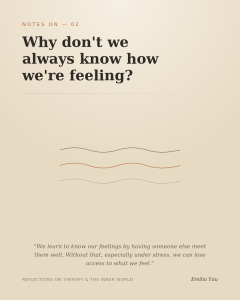
People sometimes don’t know how they’re feeling because sometimes it may feel safer not to feel.
I want to talk about something I think is really important. I remember this clearly from my own time as a lawyer. There were moments I genuinely didn’t know what I felt. Imagine if you let yourself feel just how overwhelming or anxiety provoking something really was. Sometimes it felt safer not to feel.
That’s something I now see a lot. When you’re immersed in something demanding, under constant pressure, running on deadlines and performance, it’s genuinely hard to access what you’re feeling in the moment. So we learn to cover feelings over. We lean into thinking, analysing, conceptualising, as a way to cope and keep going. It works, until it doesn’t. That’s often when burnout, anxiety or chronic stress start to show up, this can show as a breakdown in one single crisis, or more slowly where the cost of never quite letting yourself feel what was happening underneath starts to eek away at the connection you have with yourself and others.
We also learn about our feelings through our relationships with others. That’s part of why we talk things through with people, their reactions can either be rejecting or validating. If you have had experiences where it is not ok to talk about feelings again you may not want to feel or know how to identify how you feel. And it’s completely normal to have multiple feelings about something, even contradictory or conflicting ones.
So why does it matter to know how you feel? Feelings are a bit like messages. There’s a bodily response, via the nervous system, that connects up to an emotional feeling, and that feeling tells you something about your experience, or about how you’re experiencing someone else. If you’re angry, something might be wrong. If you’re happy, you’re probably doing something that feels genuinely good. Those are useful things to know, especially in high pressure professions where the instinct is often to push feelings aside and keep performing.
This is part of why, in the therapy room, I ask about feelings, and why it can take time to build a space where difficult feelings feel safe to talk about. For people who haven’t had their feelings understood, seen or validated by someone else, this is genuinely hard to do alone. We internalise the ability to do this for ourselves largely by first having someone else do it with us, and having that be a good experience.
If any of this resonates, and you’d like to talk more, about feelings, about burnout or stress, about how you think, or anything else I’ve raised here, please get in touch.
 Notes On is a series of short reflections about therapy, relationships, and the inner world. These pieces are written for anyone who is thinking about starting therapy, or curious about how therapy works, as well as for therapists and trainees who are thinking about psychodynamic ideas in practice. Each note is intended to be simple, conversational, and reflective. A way of opening ideas that can sometimes feel complicated and making them easier to think about.